
Do you have a lot of clients with Unknown Housing Status?
Regardless of your source for this piece of information — the HIFIS Health Check is one, but also just looking at your Client List and noting how many Unknowns pop up — this is most likely a spot check of current data. Based on how HIFIS currently works (4.0.61.1.3), you’re almost never going to get to 0% unknown for current/today’s data, since it’s quite likely a bunch of clients booked out of shelter this morning and are therefore now Unknown, and might be back in shelter tonight.
However, that doesn’t mean you shouldn’t try to have as few Unknowns as possible, and fill in gaps when you can.
It’s pretty obvious what the potential impact of lots of Unknown Housing Status is - you don’t have an accurate idea of how many people in your community are experiencing homelessness.
Let’s do some math here:
Let’s assume you have 1000 active clients. 400 you know to be Homeless. 400 you know to be Housed, in Transitional Housing, or in Public Institutions (I’ll call them “Housed+”), but are still accessing your services - these are the folks who are precariously housed and coming to your meal programs, or people you’ve housed recently and are still supporting in housing. Here’s what you think your homelessness data looks like:
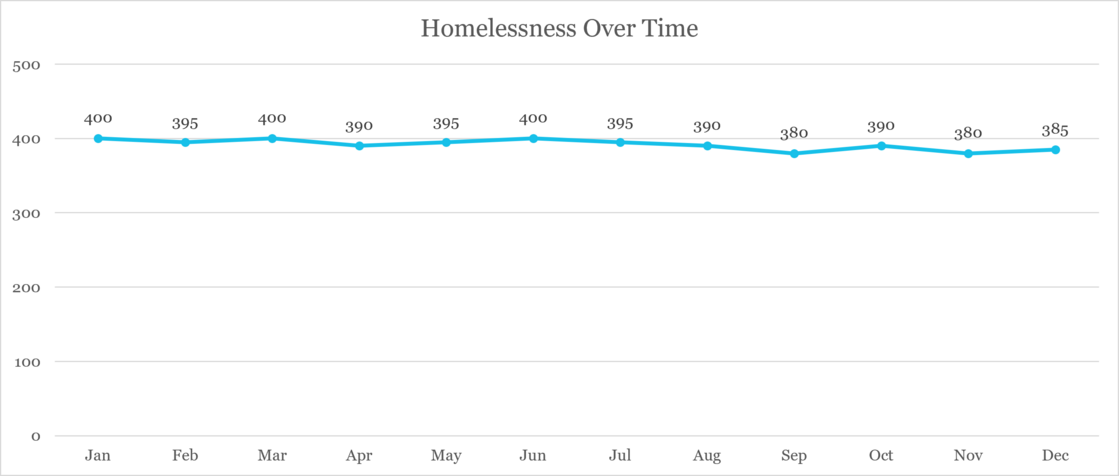
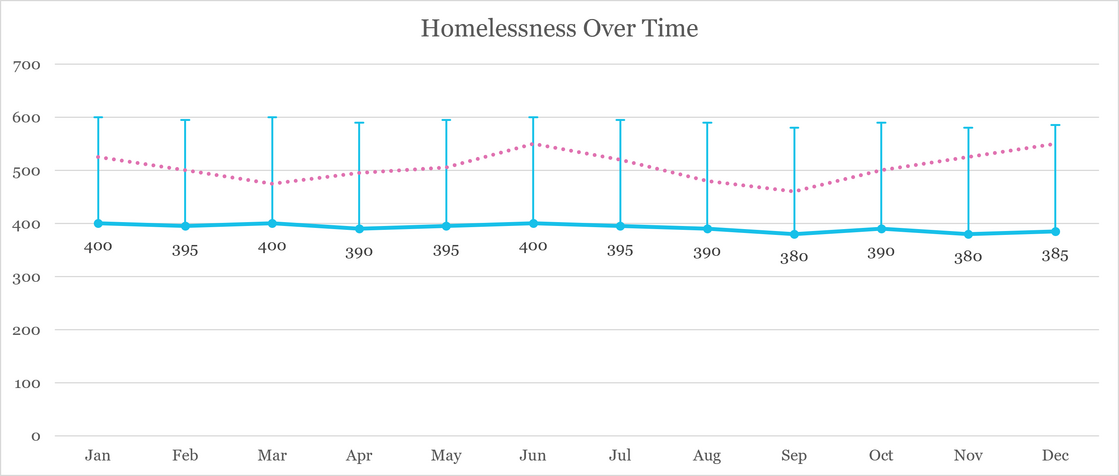
1000 active clients minus 400 Homeless minus 400 Housed+ leaves 200 people with Unknown housing status — 20% of your current clients. Those 200 people could all be homeless. That’s a total of 600 homeless people when you thought you had 400 — 50% higher. Or maybe none of them are and you only have 400 homeless people in your community. But the point is that it’s a very large amount of uncertainty, and that’s if you have only 20% Unknown. Here’s a different version of the same graph, with error bars pointing out the amount of uncertainty. In this graph, the pink line is what the real numbers hypothetically could be, and you wouldn’t even know it.
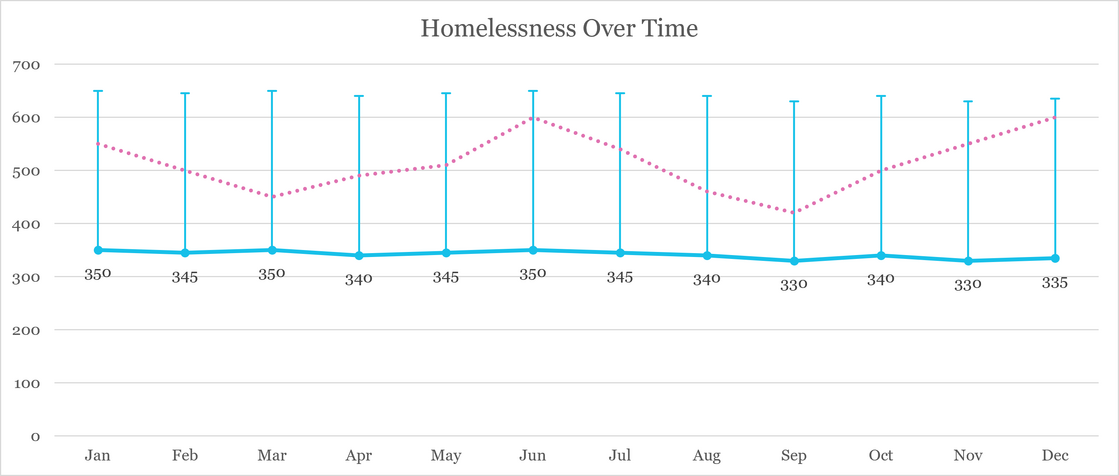
What if you have 350 Homeless, 350 Housed+, and 300 Unknown — an Unknown rate of 30%? Well you now have up to 650 homeless people. That’s almost double the number you think you have — a huge amount of uncertainty.
So how do you fix the problem? You can’t do a bulk clean-up like you can for things like open case files or duplicate clients. To make any progress, someone who knows the client needs to correct their file, and that means going through client by client and either collecting the data fresh from the client, or getting their caseworker to enter the data that they’ve been neglecting.
Looking for a way to identify Housing History gaps?
Check out our Audit Boot Camp report: Housing History Completeness 1!
ABC Housing History Completeness 1
Step one is once again to generate a list of clients with Unknown housing status. This is actually, to some extent, easier to get. Here are some ways you can do that:
If you go to Front Desk > Clients and you have the setting Restrict Client List turned off, you’ll see a list of your Active clients with a column for Housing Status. You can just go through the list alphabetically and identify these clients. See a search box instead of a list of clients? You can temporarily change that setting by going to your Cluster settings and turning off “Restrict Client List.”
Just go to the Coordinated Access module or your prioritization list, run it, and filter to show only clients with Unknown housing status. This doesn’t show all your clients, but it does show the higher priority ones - the ones that have current Coordinated Access consent.
Coordinated Access Audit - This simple report was commissioned by Lambton County to identify which clients were missing from their Coordinated Access module. It's intended to be exported to Excel and then filtered as needed, and just shows an anonymous list of clients along with their cluster, client status, housing status, Coordinated Access consent status, and whether or not they appear within the Coordinated Access module. Clients who would not appear are highlighted along with the reason they are not appearing.
Missing Fields Report - This report displays a list of clients who received services within a specified date range at specified Service Providers. The report then displays mandatory modules (defined by York Region) and indicates whether the module contains any data or not.
Quality Assurance: Clients Missing Housing Records - This report includes clients currently booked in to shelters, with no housing history record, or no updates to housing history in the past 180 days.
ABC Housing History Completeness 1 - This report contains a visual representation of the dates for which Housing History (or Admissions) data is present or absent for each recently assisted client.
ABC Housing History Completeness 2 - This 13+ page report displays useful aggregated data about how well or poorly specific shelter service providers and users are performing at collecting prior housing history data when clients present for shelter.
ABC Client Information Dashboard - This interactive dashboard allows you to review your Client Information for completeness and usage, allowing you to see overall, how many of your clients have data; which service providers and users are the most consistent at adding data; a list of which clients have the most data gaps; and review a leaderboard of top performing staff and service providers.
Now once we have that list of clients, our next step is not to just go correct them, because as I mentioned, we don’t have the ability to do so. Instead, what we’re going to do is look for groups of clients that match a pattern. In other words, we’re going to identify who is responsible for the lack of housing data.
Here are the most likely culprits:
Shelters not recording Housing History at all. When a client is staying in a shelter, their Housing Status is known to be Homeless because of the Admissions record. So, shelter workers could be neglecting to record Housing History records at all, because they’ve been trained to use the Admissions module. They should be using Housing History to record where a client stayed before they booked in, and where they went after they booked out.
Drop-in centres. High-volume, light-touch service providers like drop-in centres and meal programs might be engaged in minimal data collection and might only do something like creating a file and then adding the client to a Group Activity. Adding the client to the Group Activity keeps them active, but they have no housing data at all and there’s no way for HIFIS to even guess whether they’re housed or not.
Outreach workers using the Encampments module. Indicating that someone was found in an Encampment does not currently alter a client’s Housing Status in any way, although that may not be intuitive for outreach workers. They may assume that HIFIS would just automatically know, and therefore not have a need to record a Housing History for these clients.
Any service provider that has poor data quality in general is likely to also have a higher number of clients with Unknown housing status.
So for example, if you look at your list of clients and discover that a large portion of them have accessed a particular drop-in centre in the last month, that is one group/explanation. Set those aside, and add a to-do list item to work with that drop-in centre. Look at the remaining clients, and see if you can find another group. Say, a second group all were discharged from the same shelter in the last month. That makes group two. And so on.
It’s important to note here that the solution is not to fix the specific list of clients you came up with. The solution is to correct the practices that lead to staff not recording housing data for clients. This is going to be a multi-faceted approach - what works for one group may not work for others. It’s going to be a labour of love, so here’s your goal: every month, check to see your percentage of clients with Unknown housing status, and if the percentage is lower than last month, you’re moving in the right direction. See also How to improve your data quality for general tips and tricks.
So what are the best practices that you should be reinforcing?
For shelters:
On intake, ask for previous address. Record this as a Housing History record. This should be doable 90%+ of the time. Keep in mind that, as of 4.0.60.5, the Housing History table is now embedded in the Book-In screen, so this is much easier to do now than in older versions of HIFIS.
On exit, ask where the client is headed next. If they have an answer, record this as a Housing History record (once again, it’s now embedded on the Book-Out screen). We recognize that this is not always possible, so the instruction here is to do this when possible.
On re-entry, especially after a gap, ask the client where they stayed the previous night, and how long they were staying there. Record this as a Housing History record. This should once again be doable 90%+ of the time.
Looking for a way to identify how much previous housing data your shelters are collecting?
Check out our Audit Boot Camp report: Housing History Completeness 2!
ABC Housing History Completeness 2
For case managers:
Ensure that the clients on their caseload have an up-to-date Housing History (and Housing Status) all of the time. They should verify this information once every 30 days. (There is a “Housing History out-of-date” flag that should alert them to this.)
If they know their client to be chronically homeless but they observe that the client is not listed as chronically homeless in HIFIS, collect more information from the client and fill in the last year of Housing History.
For housing programs:
If there was an Unknown period prior to move-in, have them fill in the gap - update the Housing History - on move-in (or shortly thereafter). (For some clients that are moving in directly from shelters, this won’t be necessary.)
Ensure that housing information for their clients is always correct. This should be 100% doable since they are the ones providing housing.
For street outreach workers:
Use the Housing History to record their client’s episodes of unsheltered homelessness. It is not required to record every time that the client has moved camp, but create a Housing History record indicating something like “the client has been at an Encampment/Campsite since April.”
For drop-in programs:
This is the most challenging gap since these sorts of programs do not tend to collect a lot of personal information about their clients, but they often act as an access point where clients can connect to services. Using a progressive engagement model, identify the clients that frequently visit drop-in programs, and after they are familiar enough with the staff, ask for their housing situation.
Troubleshooting: Unknown Clients with Housing Data
This is a known bug, unfortunately. Some clients who have housing-related data are showing up with an Unknown housing status even though they shouldn’t be. We know this is sometimes related to:
When a client with a Housing History record stays at shelter, without ending the Housing History record, then is discharged from shelter and returns to the previous address (in other words, there is an overlapping Admission and Housing History), it reverts back to Unknown instead of whatever the Housing History should be.
When a Housing History is future-dated, i.e. the client will move in tomorrow, behaviour doesn’t trigger properly to make the client become Housed tomorrow.
There is a known workaround that usually works: go to the current record, Edit it, and then click Save without actually changing anything. Clicking the Save button should re-trigger the Housing Status change.
HIFIS Improvement
We are tracking a number of issues and ideas that could help your data improve on this front. If you’re interested, you can follow the links below to learn more about them. Upvote the ideas you like, comment on the ones you want to expand on, and bring them up with the HIFIS Client Support Centre and/or the HIFIS Working Group if you want to be more active on this front.
Comments