

Sometimes, we have a problem we need to solve using HIFIS. We have a new funding program that requires us to collect additional information we weren’t previously collecting. We use a particular module, but it’s missing a key functionality. We want to onboard a new provider, but they want to do things in a specific way. There’s a bug, and we need to develop a workaround.
Everybody has problems they need to solve. But sometimes we fall into a trap of putting ourselves in an invisible box and constraining our thinking, which limits our ability to solve problems in the best way.
Today, I will outline two common pitfalls that can get in our way when we’re trying to figure out the best way to make HIFIS work for us.
Maslow’s Hammer
Our first pitfall is called Maslow’s Hammer. You’ve definitely heard of this one before, commonly phrased as “if all you have is a hammer, every problem looks like a nail.” This quote is attributed to Abraham Maslow, a psychologist who is best known for his theory of the hierarchy of needs. Sometimes it’s referred to as the law of the hammer, the law of the instrument, or the golden hammer.
Here’s an example of how this comes up in HIFIS:
A shelter has been using HIFIS for a while, and they use the Admissions module to track who is in what bed (as expected). After several years, they get additional funding, renovate their building, and decide to add on some additional transitional housing units. They decide to use the Admissions module to track occupancy for their transitional units, despite the fact that this is really not the best practice. Now, to be fair, there isn’t a great option for transitional housing in HIFIS, but in this example, the shelter doesn’t take the time to explore other options, or automatically assume that they should be using the Admissions module, just because they’re used to using it. Not considering other options is the problem of Maslow’s Hammer.
The XY Problem
The XY Problem is a term you probably haven’t heard before, given to a common communication problem that can be encountered in areas like customer service, tech support and software development. It describes a situation in which an end-user thinks they have found a solution (X) to a problem (Y), but is having trouble with the solution they’ve come up with (usually because it’s the wrong solution to the problem). They state that they want to do X, but they should instead have just that they need to solve Y.
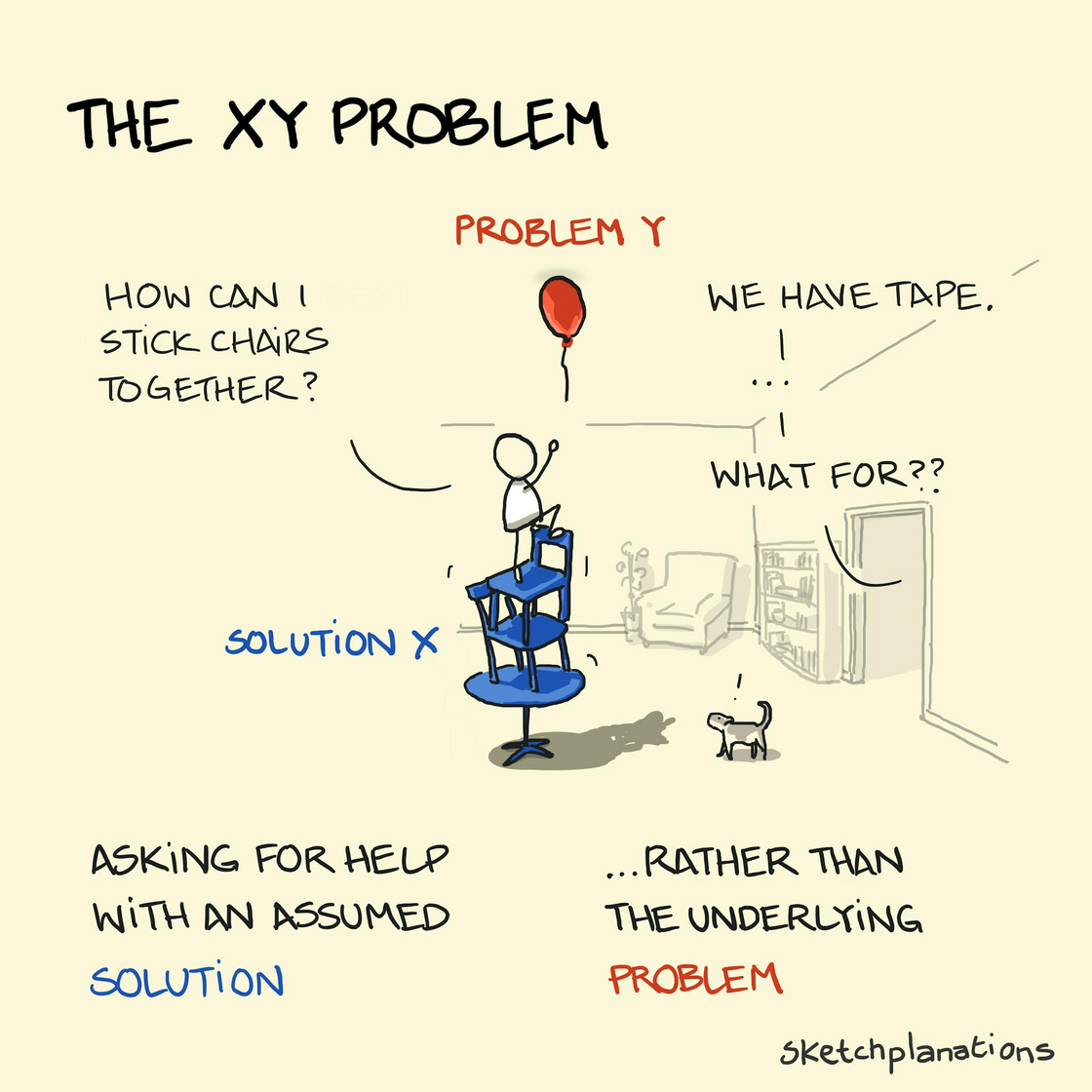
That sounds pretty vague, right? Let’s use some examples:
Millie’s car won’t start. She diagnoses the problem as a dead battery, because that’s what happened last time her car wouldn’t start. She calls her friend Oscar and asks to borrow jumper cables. Oscar comes over with jumper cables and they try jumpstarting the car, but the car still doesn’t start, because the problem was not a dead battery. What should she have done instead? She should have called Oscar and said “help, my car won’t start.”
Sam’s antique wooden chair has a loose leg, and it keeps slipping out of its socket. He decides the best way to fix it is to use a screw, but discovers he doesn’t have any of the right length. He goes to a hardware store and asks an employee for 2” long industrial screws. Sam goes home, inserts the screw, but that causes the wood to split, making the problem worse. He should have described the problem (loose chair leg in an antique wooden chair) and asked for the best solution to the problem, which may have been using wood glue and clamps, not screws.
In tech support and customer service, this problem happens a lot and can lead to a lot of wasted time. You could spend hours trying to troubleshoot an issue only to discover you were trying to solve the wrong problem. Or you could quickly resolve a seemingly simple problem, that leads to a second problem and a third problem because you didn’t understand what the original goal was.
In HIFIS, let’s go back to our shelter who is now using Admissions for transitional housing. They start to notice that clients staying in their transitional housing are still counted as homeless and eventually they’re all becoming chronically homeless. They put in a request that Admissions shouldn’t always count as homeless. However, that maybe isn’t the right solution (X) to the problem (Y). The problem (Y) is: clients staying in transitional housing are appearing as chronically homeless. The solution (X) might be that they shouldn’t be using the Admissions module for that, they should be using a different module that better fits the needs of transitional housing. Does one exist? Not currently. So maybe the correct solution (X) is to develop a new module that supports transitional housing, instead of taking a shelter-focused module and trying to shoehorn housing into it.
Here’s another HIFIS-related one: when the Encampments module was first added to HIFIS, adding a client to an Encampment didn’t flag them as homeless. That’s the problem (Y). But many communities, knowing that a client’s Housing Status is derived from the Housing History, lobbied for an Encampment record to automatically create a Housing History record for each client (solution X). That’s, quite frankly, the wrong solution. Having each Encampment record automatically create a second record in a different table is a violation of the uniqueness principle of data quality — each data element only appears in the database once — and leads to a bunch of weird questions like, what if you make the Address field mandatory and the Encampment doesn’t have an address? Instead, the better solution is: have the client’s Housing Status be derived from Encampments as well as Admissions and Housing History records; and then further: list that information in the Client’s Housing History List, in the same way that Admissions are listed there but they are not Housing History records. This is the solution that ended up getting implemented in 4.0.61.2, but I actually spent many hours in conversation with the HIFIS development team about why that was the right approach.
Case Study: the Calls & Visits Log Problem
Have you noticed that a lot of communities are using the Calls & Visits Log off-book? The official use case for the Calls & Visits Log is to record calls and visitors in a secure building, like a DV shelter. That’s what it was built for! But in all of HIFIS, this is the module that’s most frequently used for a different purpose than its intended use. How did we get to this current situation?
Because of Maslow’s Hammer, and because of the XY problem.
Here’s the saga:
A single community operated a crisis line. They used the Calls & Visits Log to record their calls, because that made sense.
They made reports that pulled data from the Calls & Visits Log. So far, so good.
They hired some new case managers to support clients. At first, they considered using the Case Management module (as expected), but they ran into some challenges with that, but one of them was they didn’t have reports that supported the Case Management module to the extent that they did in the Calls & Visits Log. So they decided that the logical solution was to use the Calls & Visits Log for case management. This is a Maslow’s Hammer problem.
A new version of HIFIS came out that introduced automated activity and inactivity. This community had a problem: all of their active clients were automatically becoming inactive, so they requested to the HIFIS development team that Calls & Visits contribute to keeping a client active. This is an XY problem. The developers agreed to solve X (Calls & Visits records don’t keep a client active) when they should have instead asked what the real problem, Y, was. If they had asked “why do Calls & Visits records need to keep clients active?” they would have eventually learned “because we’re using it for case management” which should have resulted in a solution like addressing any problems in the Case Management module that discourage caseworkers from using it.
Other communities occasionally also ran into problems where some clients would automatically go inactive despite being active in case management. In many cases, they had an open Case File, but no activity within the case file because staff were using a different tool for case management. Communities would reach out to the HIFIS support team and say “my clients are going inactive!” and the HIFIS support team put out the official recommendation that they, too, should add Calls & Visits records to keep clients active. This is, once again, a Maslow’s Hammer problem.
So now you have a whole bunch of communities using the Calls & Visits Log for no good reason because of a series of Maslow’s Hammer and XY problems. I have heard from multiple communities about their efforts to stop using the Calls & Visits Log and encourage caseworkers to just use the Case Management module properly, and it’s really quite hard to correct a practice like that.
What Can We Learn?
It’s easy to fall into these in-the-box thinking traps when we are rushed and don’t take the time to think through a problem. But you can also avoid them by following a simple procedure.
First, if someone comes to you with a request that seems a bit odd to you, like “can you add this value to the drop-down menu?” or “my staff need access to the Storage module” or “I need a new custom table,” stop and ask them: what problem are you trying to solve by doing that? In other words, push back and ask why. Why do they need that value in the drop-down menu? Why do they need the Storage module? Why do they need a custom table?
Once you have identified a problem and a potential solution, whether it originates from you or if it is brought to you by someone else, follow these steps:
Identify the actual problem you are trying to solve
What’s the first solution that comes to mind when you try to solve it? It might be tempting to stop here, but don’t. Go to step 3!
Identify any drawbacks to this solution. If there are no drawbacks (really?), then go ahead and implement this solution. Otherwise, keep going.
Ask: is there another way the problem can be solved? If you can’t think of any, that’s okay. It’s not necessarily your job to find the right solution.
Have you found a drawback-free solution that you can implement yourself? If so, go for it. Otherwise, keep going.
Escalate. Whether you’re bringing this up to the HIFIS support centre or you’re bringing it up to your local HIFIS working group, clearly articulate the problem (step 1). Share the solutions that you have thought about (steps 2 and 4) along with the benefits and drawbacks of each. See if anyone else has a different approach. Remember that the best solution might be one you haven’t even considered!

I hope this discussion will help you to avoid some common thinking traps that can get in the way of making the best use of HIFIS, and allow your community to make better informed decisions about HIFIS use!

Comments